Duke Researcher Misleads on Vinyl Flooring

Duke Researcher Misleads on Vinyl Flooring


Dr. Heather Stapleton’s recent study on vinyl flooring uses flawed methodology to draw a host of misleading conclusions. Those in the press who reflexively publicize her findings -- and fail to include important facts and context to help the public decide whether her claims are scientifically reliable -- do a disservice to readers everywhere.

Collaboration with Anti-Vinyl Organizations

Dr. Stapleton is not an independent authority on this issue.  She has collaborated with the Environmental Working Group (EWG) -- a group that has been ideologically opposed to vinyl flooring for years. EWG has called vinyl flooring “the worst flooring choice,” and the group’s distortions about vinyl material have been publicly corrected in the past. 

What’s more, Dr. Stapleton’s laboratory, The Stapleton Lab, is housed within Duke University’s Nicholas School of the Environment -- which partners with other organizations that have engaged in decades-long campaigns to deceive the public about vinyl. Specifically, it runs an affiliated internship program with Greenpeace, which actively campaigns against PVC material. Other internship partners include EWG and Earthjustice, another staunch opponent of the PVC industry.  

Combined, these relationships raise serious questions with respect to Dr. Stapleton’s independence on this important subject. 

Problems With Dr. Stapleton’s Study

Her research focuses on a specific phthalate called benzyl butyl phthalate (BBP), which Dr. Stapleton claims causes health issues in children exposed to vinyl flooring in their homes. Here’s the problem: very little vinyl flooring sold in the United States today contains BBP. 

What’s more, her research relies on observational data by individuals who are not trained experts in distinguishing different flooring material types to determine whether, or how much, vinyl flooring was present in the homes of test subjects. And as any respected researcher knows, survey data is widely considered to be an unreliable data source. Notably, it is impossible for Dr. Stapleton to confirm that the vinyl flooring in the homes of the subjects in her study even contained BBP -- and verifying that is essential to the study’s overall credibility.  And Dr. Stapleton’s study failed to consider that the presence of BBP could come from a number of sources. After all, a study is only as good as its methodology

She also fails to note that no credible science exists anywhere claiming a connection between phthalate exposure and impacts to human health.  

Even more egregious, Dr. Stapleton’s own study shows that the levels of BBP that the children were exposed to were far too low to be of concern. According to her paper, even the greatest possible exposures were at least 25 times below the safe level as determined by the U.S. EPA. In other words, none of the children profiled in this study were in danger of exposure-related health concerns. There is simply no evidence in this study that children living in homes with vinyl flooring are at any greater risk than children living in homes with no vinyl flooring.

Alarmist findings may be attractive for media outlets to cover. But when the press blindly cover studies that rely on unscientific methods -- and fail to question their conclusions or provide important context regarding the author’s independence or credibility -- the public loses.  Readers can only make informed judgments when they have access to all of the facts

And a flawed study by an agenda-driven researcher does not change what years of credible science and real world use has proven -- vinyl flooring remains one of the safest, most reliable products on the market today. 


The Spruce Flip-Flops on Vinyl Flooring

The Spruce Flip-Flops on Vinyl Flooring


It’s unusual when a writer correctly addresses the benefits of vinyl material -- then publishes a slew of deceptive attacks against vinyl flooring just a few months later. 

But when that same writer runs a business specializing in a competing flooring material, the dots start to connect. 

In a May 2019 article, Joseph Lewitin, a guest writer for the home improvement site “The Spruce,” penned a glowing review of the many qualities that make vinyl flooring an excellent option for homeowners:

“Vinyl flooring is a durable and resilient material that is both stain- and water-resistant, but perhaps the real draw is its versatility. Vinyl comes in tiles, sheets, and planks and can be printed with an almost endless array of colors, patterns, and textures. It can look like natural materials or contain complex geometric patterns with a range of vibrant, eye-catching colors.”

He continued: 

“Vinyl flooring can be manufactured to closely resemble any of a number of natural materials. … The faux wood has a rich golden hue that pairs pleasantly with the white cabinets and the hardwood furnishings in the space. The flooring combines the visual appeal of hardwood with the durability and easy maintenance of vinyl. … Vinyl is ideal for mimicking traditional tile work, such as tessellation or Victorian motifs. The color combinations are almost endless, and the details are as fine as those of hand-laid tiles, all in a material that you can install yourself.”

So we were admittedly confused when he changed his tune a few months later in an August 2019 article in the same outlet titled “The Environmental Impact of Vinyl Flooring.” In it, Mr. Lewitin repeats many of the same irresponsible claims about vinyl flooring that agenda-driven opponents of the material have perpetuated for years. We’ll be specific: 

  • He portrays the PVC manufacturing process as a major producer of dioxin -- he’s wrong. Based on the 2017 EPA Toxic Release Inventory Data, chlor-vinyl dioxin emissions to air and water is 5% of all regulated sources of dioxin. Unregulated sources, such as uncontrolled burning like forest fires account for the majority of dioxin emissions in the U.S. In fact, residential wood burning has been estimated to be double the amount of dioxin emissions to air from PVC resin production.

  • He incites baseless fear and hysteria over phthalates in vinyl floors -- but neglects to mention no credible science exists that remotely suggests these additives create any negative impact on human health.

  • He stokes alarmism by claiming the storage facilities for chlorine used to make PVC could be exploited by terrorists -- but he omits that these plants have dramatically improved their security procedures and work closely with the Department of Homeland Security to prevent such an event. 

  • He claims vinyl flooring emits volatile organic compounds (VOC) -- but neglects to mention that vinyl flooring products are low emitters and that manufacturers certify their products to the very stringent California VOC emissions standard.

  • He singles out emissions of vinyl flooring in house fires, but he fails to note that all materials -- including wood -- emit harmful chemicals in the event of an accidental fire

  • He insinuates that asbestos is used in adhesives for vinyl tile installation -- he’s wrong (again). Asbestos formerly used in one type of adhesive has not been used in the last 35 years.

  • He misrepresents vinyl flooring tile’s environmental qualities. He makes broad, baseless claims to vinyl flooring’s composition, recyclability and disposal. But the material’s superior durability and longevity minimize energy use by requiring fewer repairs and avoiding frequent replacement when compared to other flooring materials.

This brings us to an important question: Why did Mr. Lewitin make a sudden 180° on vinyl flooring? The Spruce points out that Mr. Lewitin “started his own business specializing in stone flooring,” which is a direct competitor to vinyl flooring. And with vinyl flooring increasing in popularity everywhere, perhaps he realized that scaring the public with deceptive claims about competing materials -- instead of conveying the facts -- is a more effective business strategy. Readers are also right to wonder why the editors at The Spruce didn’t pick up on Mr. Lewitin’s turnabout on vinyl flooring -- and published his piece filled with misleading characterizations about vinyl material despite the possible conflict of interest. 

Vinyl flooring is one of the safest, most durable, resilient and versatile products on the market today. Readers deserve to have the facts on flooring issues -- not competitively-motivated views disguised as independent commentary.


Consumer Reports Misleads Readers on PVC

Consumer Reports Misleads Readers on PVC


A recent article in Consumer Reports is riddled with misleading claims about the safety of PVC products. When we brought these errors to the attention of the editors at Consumer Reports, they corrected only the most egregious and indefensible mistake and ignored the rest. In the interest of transparency, it’s important that readers know there are a number of other inaccurate and misleading points in the outlet’s one-sided article -- points Consumer Reports declined to correct. 

Mr. Loria, the author of this article, incorrectly suggests that phthalates used in PVC products are unsafe. The truth is that phthalates have been safely used in consumer and commercial products for more than 50 years. Rigorous risk assessments by government agencies in the U.S., Europe, Canada, and Australia have all concluded that phthalates present low-risks in their intended use. He irresponsible stokes unnecessary fear of perfectly safe products. 

Mr. Loria also bases his story on a study that used contrived conditions with very little applicability to real-world use of plastic products. The study itself notes that “it is important to highlight that [the researchers’] aim was not to draw conclusions regarding the health impacts of plastics” [emphasis added]. 

But that is exactly what Mr. Loria does in his article. Even though he includes a caveat that plastic products “aren't necessarily harmful to human health,” he uses these flawed findings to advocate for the avoidance of plastics whenever possible. He also presents the findings of the study with very little qualification or discussion of their limitations. As a result, readers are misled to believe that the products they use every day are, in fact, harmful. And it doesn’t live up to the high standards of an organization that self-proclaims an adherence to  “truth, transparency, and fairness in the marketplace.”

Quite the opposite.  Mr. Loria ignored journalistic standards of fairness and sourcing by not seeking comments from anyone with a dissenting view. The result is a one-sided article that fails to provide readers with the facts and context they deserve. Had Mr. Loria contacted any organization with a view contrary to his preferred narrative, he would have been informed of his errors and given critical context on the issue to ensure that his readers were not misled. 

We brought this oversight to the attention of Consumer Reports and provided them with the statement below. They elected not to print it and chose, instead, to deny their readers a balanced view of the issue. Here is the statement we asked them to include in the article:

Consumers have a right to the facts — and they indisputably show that PVC is a safe and reliable material. The study at the center of this article offers no evidence to support the claim that PVC or other plastic products pose any human health risk in normal use. Phthalates in flexible PVC have been safely used in consumer and commercial products for more than 50 years and rigorous risk assessments by government agencies in the US, Europe, Canada, and Australia have concluded that they present low-risks during intended use. 

Sadly, this kind of one-sided and misleading treatment is all too common in reporting on PVC products. Publications like Consumer Reports should provide consumers with a complete picture regarding the products they use. The public deserves better than slanted coverage from outlets claiming to look out for their best interest. That’s why we will continue to hold those reporters and outlets accountable when they miss the mark on PVC.

MORE: Getting Smart Around Phthalates


A Roundup of Junk Science Claims About Vinyl

A Roundup of Junk Science Claims About Vinyl


In the last few weeks, we’ve seen several outlets post misleading or otherwise false claims about vinyl products. So we decided to round them up and debunk each one.

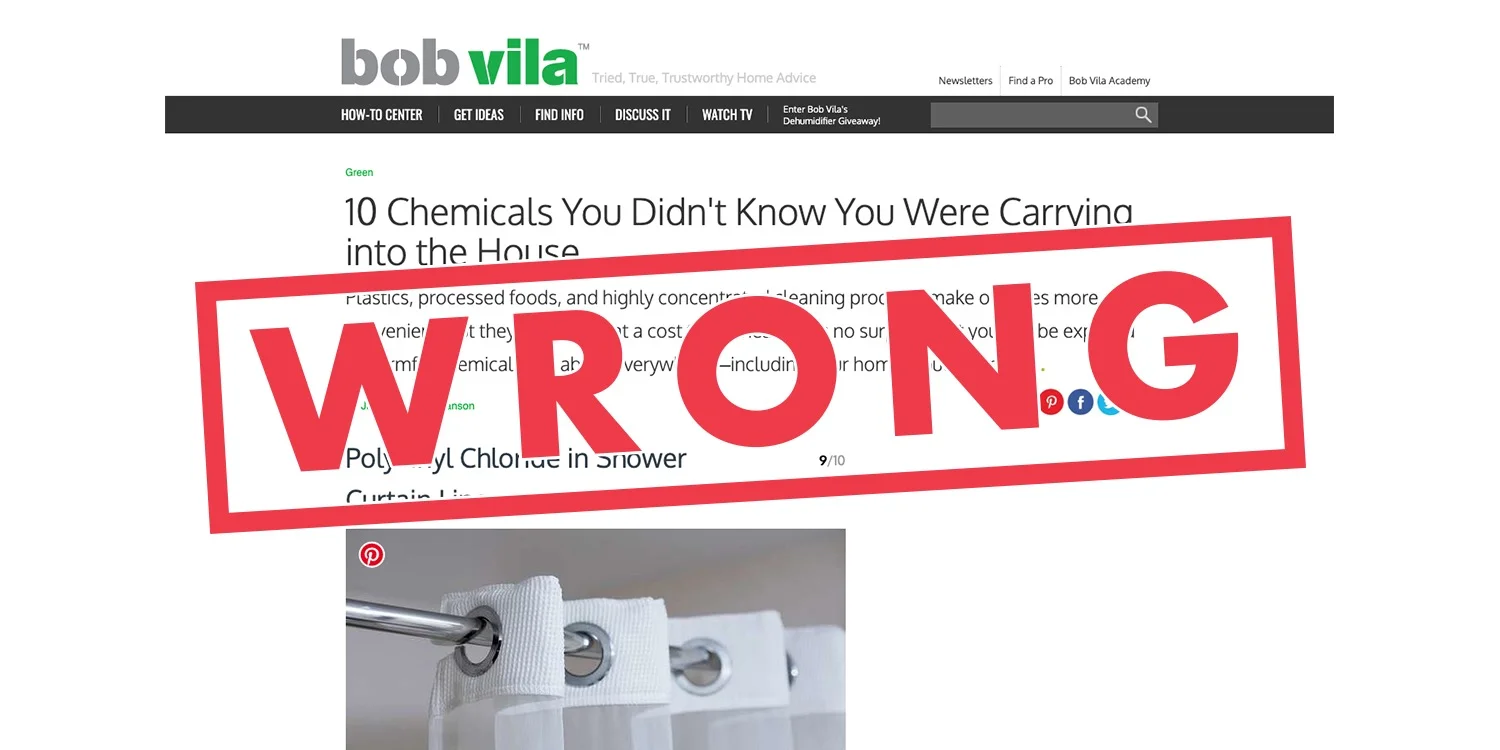
BobVila.com Misleads Readers on Vinyl Flooring and PVC Shower Curtains

 
bob_vila_misleading copy.jpg
 

BobVila.com recently claimed that plasticizers used in vinyl flooring can be dangerous. The truth is that phthalates have been safely used for decades. Even the strictly regulated State of California has researched and now issued “safe use determinations” for plasticizers in vinyl flooring and vinyl carpet tiles employing a variety of phthalates. Vinyl flooring is safe, durable, attractive and cost-effective. That’s why homeowners and builders choose it over other more expensive products.

They also claimed that PVC shower curtains can be harmful to human health. In fact, PVC is perfectly safe when used in shower curtains. BobVila.com engages in sensational, fear-mongering language with no evidence to support their claims. PVC is an inert material and is not considered a carcinogen by any authoritative body.

MORE: Columbia Researcher’s Careless Statement On Vinyl Flooring

MORE: The Environmental Working Group is Wrong About PVC Shower Curtains


Business Insider Promotes Junk Science on PVC Bibs

 
business_insider_junk_science copy.jpg
 

Business Insider recently claimed that PVC baby bibs can contain lead. They don’t. U.S.-made PVC bibs have never contained lead, and importers discontinued using lead in these products over a decade ago. 

MORE: What Makes a Good Study?


The Independent Stokes Unnecessary Fear About Phthalates

 
independent_fear_mongering copy.jpg
 

The Independent recently promoted sensationalist claims about phthalates used to make rigid vinyl flexible. Phthalates have been safely used for more than 50 years and are some of the most tested substances in the world. Rigorous risk assessments by multiple government agencies in the United States, Europe, Canada and Australia have concluded that many phthalates present a low-risk for their current intended uses.

MORE: Getting Smart Around Phthalates and PVC


National Geographic Misleads Readers on PVC Plastic Wrap

National Geographic Misleads Readers on PVC Plastic Wrap


In a recent article, National Geographic reporter Sarah Gibbens relies on a series of unfounded claims about the health and environmental impacts of PVC to criticize plastic wrap products like Saran™ Wrap. Worse, the article confuses readers by referring to compounds interchangeably while falsely implying that products like Saran Wrap contain chemicals that have been absent for decades. Here are the facts:

Saran™ Wrap is not made with polyvinylidene chloride or vinyl chloride in any form. Saran™ Wrap does not contain chloride. It is made from polyethylene -- and has been for more than 15 years in the U.S. market. In fact, Ms. Gibbens notes that Saran™ Wrap transitioned away from polyvinylidene chloride years ago, but later contradicts herself by erroneously claiming that it still contains as much as 13% vinyl chloride. If the reporter can’t get her facts straight on even this most basic issue, how can readers trust any of her claims?

There is no health risk to “wrapping [your] food in a plastic made with chloride.” Virtually all food contains chloride in far higher quantities than could ever be replicated by contact with PVC wrap. Sodium chloride, or table salt, is one of the most common ingredients in the average diet. It is used as a preservative, a flavoring aide, and in the curing process. The kind of sensationalist language used by Ms. Gibbens is overblown and not based on fact. 

The FDA does not regulate the use of PVC in food packaging in the way the author describes. Ms. Gibbens claims the FDA regulates PVC food packaging, yet the source she cites is an FDA guidance document – not a regulation – for calculating the average amount of a person’s diet that comes into contact with certain materials. The guidance document makes no claims about safety. If Ms. Gibbens is referring to a different “regulation,” she should produce it for her readers. 

PVC does not release dioxins in landfills.  The author is misrepresenting information from the National Institutes of Health (which she incorrectly attributes to the World Health Organization). As we’ve explained before, dioxins are a byproduct of nearly every material when burned in an accidental fire. And PVC is no different from any other material in this regard. Ms. Gibbens should take better care to accurately represent the science. 

DEHA plasticizers have been used for years with no harmful health effects. The author claims the “effects [of DEHA] on human health are unclear.” Yet she disregards the findings of the Consumer Product Safety Commission (CPSC), which completed a toxicity review on DEHA and found that it has been thoroughly studied over five decades -- and any health concerns are unproven or lack human relevance. 

This piece is a prime example of journalistic malpractice (which is becoming a pattern for National Geographic). As explained above, the piece gets it wrong on the facts – big and small – and stokes baseless panic among readers about products that are perfectly safe and have been in use for decades. As long as media outlets continue to promote this kind of misinformation, we will continue to do their homework for them -- and hold them accountable. 

MORE: National Geographic Misleads Readers On Vinyl And Phthalates


National Geographic Misleads Readers on Vinyl and Phthalates

National Geographic Misleads Readers on Vinyl and Phthalates


National Geographic recently published a story containing misleading and irresponsible claims about vinyl products and phthalates. The reporter disregarded her journalistic responsibility to report the facts and chose to feature a number of sensationalist allegations that have no scientific credibility. Here’s what she got wrong:


Greenpeace Distorts Facts on PVC

Greenpeace Distorts Facts on PVC

A recent Greenpeace report ranking retailers on their policies regarding the use of plastics makes a number of inaccurate and misleading references to PVC (polyvinyl chloride). We’ll correct them here: 

Greenpeace Distortion

“Retailers should prioritize eliminating the most problematic and unnecessary plastics that are harmful to human health; that regularly enter the environment; that are not recyclable, or often end up in landfills or incinerators despite recyclability claims; and that have existing alternatives. Problematic and unnecessary plastics include, but are not limited to, polyvinyl chloride (PVC) [...]”

Indisputable Facts: 

PVC has been safely used in thousands of commercial and consumer products for over half a century. There is no scientific evidence showing PVC to be “harmful to human health” when used for its intended purpose. In fact, PVC provides enormous human benefits by replacing glass and other materials that can shatter or cause potential harm. It also offers better sanitary alternatives in applications such as food packaging.

More vinyl is recycled in the U.S. and Canada every year than exists in all of the landfills in both countries. Since 2014, there has been a 40 percent increase in post-consumer vinyl recycling. Even more impressive, of all the plastics in landfills, vinyl makes up less than 3 percent -- and only 0.8 percent of all landfilled material is PVC. That’s because vinyl products are built to last, as the vast majority of PVC that’s ever been produced is still in service today (PVC pipe can last more than 100 years).

We will always push ourselves to do more. That’s why we just announced a new industry-wide sustainability initiative called Vantage Vinyl with the goal of further improving the sustainability of vinyl products.

Greenpeace’s claims against PVC are nothing new -- the group has been ideologically opposed to PVC for decades, evidenced by its long track record of spreading disinformation about our industry. Those who spend the time to learn the facts are well aware that Greenpeace’s claims about PVC have little credibility.  

As long as groups like Greenpeace perpetuate inaccurate narratives about PVC in the public discourse, we’ll continue to hold them accountable by setting the record straight.