The Intercept Ignores Key Facts in Agenda-Driven Story On PVC Industry

The Intercept Ignores Key Facts in Agenda-Driven Story On PVC Industry

Reporter Schuyler Mitchell, with The Intercept, a self-proclaimed “adversarial journalism” online publication, contacted the Vinyl Institute after 4 pm on February 16th with a host of questions demanding answers within a few short hours.  The Vinyl Institute responded, but as expected, very little, if any, of our fact-based information made it into her 2,250-word story which was published just a day-and-a-half day later – a piece she obviously had been working on for many weeks.

We’re posting our response, in full, to ensure the public has access to all of the facts, so that they may draw their own conclusions – and avoid being duped by Mitchell’s deceptive portrayal of our industry.

Mitchell ignored an independent third-party study by McKinsey we provided that shows products made of PVC are less carbon-intensive compared to others made of competing materials. But that didn’t make it into her story.

Mitchell spent considerable time quoting information from the Vinyl Institute’s website – yet she avoided any mention of the vinyl industry’s safety and sustainability commitments, and the substantial progress the industry has achieved in recent decades. Points such as:

  • Safety is the number one priority for the vinyl industry – and the facts prove it. PVC has a long history of being manufactured responsibly, evidenced by our safety record.  

    • U.S. vinyl producers’ Occupational Safety and Health Administration (OSHA) recordable incidence rate is 67% lower than the entire chemical industry, and 80% lower than the recordable incidence rate of all manufacturing.  The Vinyl Institute annually recognizes vinyl producer facilities for their safety performance. In 2022, 30 facilities were commended for their safety performance for the calendar year, and 13 of those facilities received special recognition for operating for five or more consecutive years without an OSHA recordable incident.

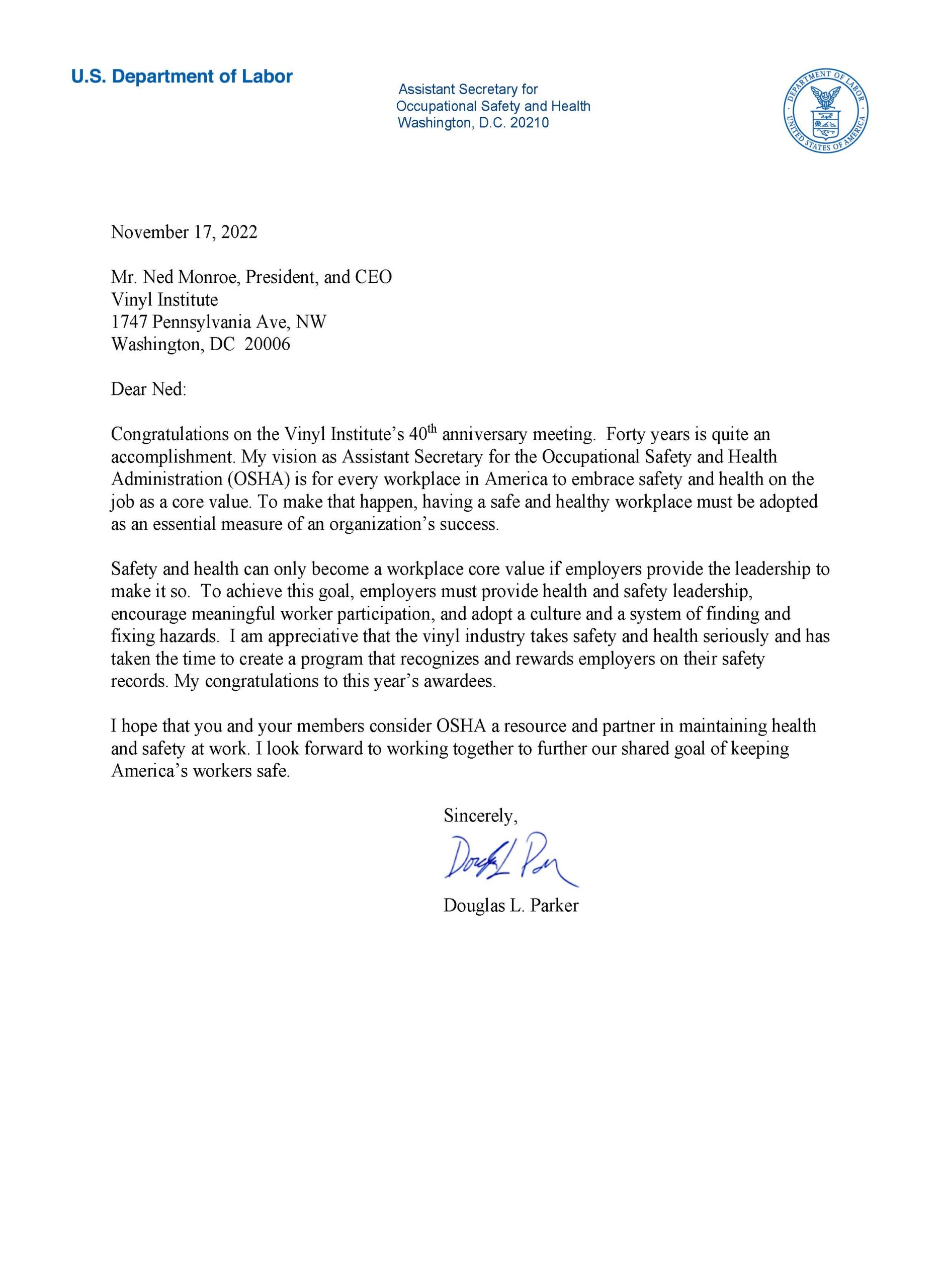
    • And, the Assistant Secretary for Occupational Safety and Health, Douglas Parker, sent VI members a letter just a few months ago commending the industry on our safety performance record.

  • Vinyl producers have significantly reduced ambient emissions. PVC resin manufacturers have reduced ambient emissions since 1987 by almost 90 percent according to U.S. EPA Toxic Release Inventory data – during the same time production volume has doubled.

  • Billions of pounds of PVC have been recycled. More than 1.1 billion pounds of PVC materials are recycled annually in the U.S. and Canada. This amount includes 958 million pounds of pre-consumer PVC materials and 142 million pounds of post-consumer PVC materials.

  • The vinyl industry’s commitment to sustainability is indisputable. The Vinyl Institute established the Vinyl Sustainability Council, a collaborative platform for companies, organizations, and other stakeholders to advance the U.S. vinyl industry’s contribution to sustainable development. So far, we’ve published 3 sustainability reports documenting our transparent progress.

Mitchell deceives readers about the Vinyl Institute’s lobbying efforts. She claims the VI is “… pressuring Congress to require ‘open competition’ in designing and bidding on water infrastructure, to ensure that PVC pipes are included in considerations.” Yet she hides from readers that municipalities (and their taxpayers) experience a 30% decrease in the cost of piping materials when open competition is adopted – regardless of what type of piping material is ultimately selected for the project. We provided her with an independent, third-party study that supports this, but that too failed to make it into her story.

We’re confused by Mitchell’s suggestion that saving taxpayers money in this regard is a bad thing.

The Vinyl Institute advocates on behalf of its members and the more than 2,900 companies throughout the vinyl value chain that employ more than 350,000 people. From healthcare, communications, and aerospace to automotive, retailing, textiles, and construction –  PVC’s proven track record has made it a material of choice for industries everywhere.

Here’s the full text of the response we provided Mitchell (which we sent despite her untenable deadline). She ignored most of it:

The Vinyl Institute advocates on behalf of its members and the more than 2,900 companies throughout the vinyl value chain that employ more than 350,000 people. We educate lawmakers about PVC and its life-enhancing contributions to society.

Few materials used to produce durable goods and building products can claim the same environmental benefits of PVC when the entire life cycle is taken into account. A disinterested third-party comparative study by McKinsey shows pipes made with PVC are less carbon-intensive compared to similar pipes made from other materials, especially ductile iron.

The safety of PVC’s use in water infrastructure is well established. PVC pipe complies with NSF/ANIS/CAN 61 standard, which is the legally recognized standard in the U.S. and Canada. This standard ensures that all materials, including PVC pipe, do not contribute harmful levels of contaminants to the drinking water.

PVC’s performance and durability are also well established. PVC pipe has the lowest break-rate when compared with other piping materials. It has a service life of more than 100 years. And contrary to iron pipe, PVC pipe is not susceptible to corrosion, therefore, less energy is required to pump water through PVC piping system over the course of its service life.

We support an open bidding process because it allows for transparency and increased competition where all water pipe material options can bid. Studies show that when municipalities have an open bidding process, the cost of all piping materials decreases by 30% or more, no matter what material is selected. This saves taxpayers money and allows municipalities to modernize crumbling and leaking water infrastructure.

We do not support the proposed Break Free from Plastic Pollution Act because, if passed, plastic production will increase overseas in countries that have occupational safety and health regulations and environmental protection laws that are commonly less stringent than the regulations in the United States.

Mother.ly Follows the Pack With Shoddy Story on PVC and Phthalates

Mother.ly Follows the Pack With Shoddy Story on PVC and Phthalates

It’s hard to go a single day without reading alarming stories falsely linking phthalate exposure with some alleged human health hazard.

We say “falsely” because credible experts and federal regulators alike have consistently found that these plasticizers are safe at common, every day exposure levels. Despite this robust scientific consensus, the press routinely publishes misleading news reports claiming phthalates cause dozens of maladies.

Consider this recent story, “Phthalates cause uterine fibroids, in vitro study confirms,” authored by Kristen Fischer and published by Mother.ly. The article contains a number of deceiving claims about phthalates and PVC. Let's briefly clear up Fischer's confusion.

Phthalate safety: what you should know

First, the new study focuses on a single phthalate called di-(2-ethylhexyl) phthalate, or DEHP. Fischer summarizes the results as follows:

In the report, the researchers found that women who were exposed a lot to … DEHP … had a high risk for having a symptomatic fibroid … DEHP is just one phthalate, but it’s the most widely used one.”

Fischer fails to clarify in her piece that in the United States, DEHP is primarily utilized in sterile and critical medical devices such as blood bags and plasma storage containers, not for food-contact uses.

Regarding any exposure to phthalates in the diet, determinations by U.S. regulators have affirmed the safety of phthalates in food packaging. A 2018 report by the U.S. Food and Drug Administration (FDA) on phthalates used in common food-contact materials noted:

There have been no studies to date which show any connection between human dietary exposure to phthalates and adverse health effects.” And in May 2022, after years of analysis, the FDA added that it did “not have a basis to conclude that dietary levels from approved ortho-phthalates exceed a safe level.”

The FDA also noted that diethylphthalate (DEP), the only phthalate commonly used in cosmetic products, is unlikely to pose a risk to consumers. “Based on currently available safety information,” the agency also wrote in May 2022, “the FDA does not have safety concerns with the use of DEP as currently used in cosmetics and fragrances.”

This product contains phthalates?

Beyond ignoring key regulatory determinations about phthalate safety, Fischer implies that Americans are exposed to greater quantities of these plasticizers than they really are. She claims that consumers can identify which plastic products contain phthalates by looking for certain markings that are molded into these items. “Check for a number 3 inside the universal recycling symbol along with the 'V' or 'PVC' below the arrows,” she suggests.

This description leads readers to believe that all PVC products contain phthalates—which is false. Rigid PVC products, including most flexible-wall plastic containers, and most, if not all, PVC storage containers and food wraps, do not.

We followed up with Fischer to make her aware of these points on January 9th. She ignored us. So here we are, yet again, correcting another story that seeks to scare people about PVC and phthalates when the facts, reaffirmed by U.S. regulators, show there’s nothing to worry about.

The ultimate problem with Fischer's story is that it unnecessarily urges readers to fear products that have been safely used and thoroughly studied by experts for more than 50 years.

Environmental Health News Spreads Falsehoods About PVC and Phthalates in Medicine

Environmental Health News Spreads Falsehoods About PVC and Phthalates in Medicine

“Phthalate-contaminated” medical devices jeopardize the health of newborn babies, Environmental Health News (EHN) intern Ashley James asserts in a recent story titled, “What will it take to give babies a phthalate-free start in the world?

While undoubtedly well-intentioned, her article misrepresents the available evidence and downplays PVC’s important health care applications, confusing and alarming EHN readers instead of educating them.

James’ thesis centers on a chemical called Di(2-ethylhexyl) phthalate, typically abbreviated to DEHP. It’s a plasticizer commonly added to some PVC products to make them more flexible, including blood bags, sterile tubing and other vital medical supplies used safely in hospitals the world over.


Evidence of harm? Context is key

James alleges a link between phthalate exposure for newborn infants with “several toxic endpoints” that cause harm to human health. Her claims aren’t supported by reliable scientific research. What’s more, they don’t tell the whole story. Studies have shown that infants are exposed to various chemicals, including phthalates. But no credible scientific evidence has found that these exposure levels are harmful. Writing for the Genetic Literacy Project last year, Dr. Sam Moxon helpfully summarized this important point:

Studies have demonstrated detectable levels of phthalate metabolites in human urine and these are often viewed as concerning because phthalates can be toxic but likely at a much higher dose than observed in humans.”

The U.S. Centers for Disease Control and Prevention’s (CDC) Agency for Toxic Substances and Disease Registry (ATSDR) made an equally significant observation in 2022, explaining that:

[H]uman epidemiology studies evaluating potential adverse effects from exposure to phthalates (including DEHP) are insufficient to draw firm conclusions regarding cause and effect or dose-response for individual phthalate esters.”

ATSDR made several other pertinent observations in an earlier analysis that James and other critics of phthalates often overlook. Specifically, the agency found that:

DEHP, at the levels found in the environment, is not expected to cause adverse health effects in humans.”

Also missing from James’ story is a reference to a 2022 finding by the U.S. Food and Drug Administration on phthalates and direct contact with food packaging, where the agency stated:

[W]e do not have a basis to conclude that dietary exposure levels from approved ortho-phthalates exceed a safe level.”

Any connection James tries to make between phthalate exposure and human health falls flat, as she draws conclusions which credible scientific studies do not support, and ignores findings by U.S. government agencies that contradict her thesis.

Risks vs benefits

Are there benefits to using phthalate-containing PVC medical supplies? And do those benefits play a major role in advancing public health? The answer is “yes” in both cases. Hospitals rely on blood bags containing DEHP because it “makes them robust to the manufacturing and sterilization process, and able to withstand the diverse challenges of processing and storage conditions,” the authors of this 2011 evidence review explained.

James counters in her EHN piece that PVC alternatives already exist. What she fails to mention is that these substitutes can’t deliver the same strength, durability and versatility as PVC. Bags made from other materials can hinder a hospital’s ability to preserve blood for extended periods, raising uncertainty about the availability of blood when it’s most needed.

PVC medical tubing offers another key example of DEHP's important role in healthcare. Clinicians require transparent, kink-resistant tubing to monitor fluid movement and ensure a consistent flow of fluid or oxygen to patients. That's why PVC is frequently specified for these applications; hospitals can't take a chance on other materials when their patients' lives are on the line. The American Academy of Pediatrics (AAP) agrees. In a 2003 report James cited (but did not quote) the APP wrote that:

DEHP has important characteristics that improve the function of medical devices. Any substitutes must be shown to be toxicologically safer and functionally equivalent.”

We agree with James that protecting the health of young children is essential. We do that by giving medical professionals and healthcare facilities the tools they need to provide the best care possible. Making speculative claims about the dangers of phthalates does nobody any good.

HuffPost Refuses to Tell the Truth About Water Bottles

HuffPost Refuses to Tell the Truth About Water Bottles

“The plastic packaging of your beloved bottled water may pose certain health risks,” HuffPost guest writer Daryl Austin reported in a September 2022 story. “Here's what experts want you to know.”

Although Austin marketed his story as an expert-guided analysis, his article misreported basic facts about phthalates and water bottles, cited irrelevant sources, and left readers with the impression that they face a serious health threat which the science doesn’t support. 

And when we reached out to Austin and his editors repeatedly to point out the flaws in his piece, they declined to respond to our inquiries.

In fact, we contacted them four separate times, politely asking that they correct the glaring errors in the story to avoid deceiving the public. Since these requests were ignored, we offer this rebuttal in an effort to do what HuffPost refused to do—tell the truth.

Austin’s mistakes began just three paragraphs into his story: “Phthalate exposure has been warned against because of how the chemicals affect a person’s endocrine system, which is the system that produces and releases hormones,” he wrote. He tried to support that claim with a link to two facts sheets, one from the U.S. Centers for Disease Control and Prevention (CDC), the other from the U.S. Environmental Protection Agency (EPA).

But the CDC document didn't even mention water bottles. And the EPA citation included a key point Austin left out of his story: “Several studies have shown associations between phthalate exposures and human health, although no causal link has been established.”

The U.S. Food and Drug Administration (FDA) went even further. In a May 20, 2022 regulatory decision, the agency declared phthalates safe for food contact, stating: “based on the information currently available to FDA, we do not have a basis to conclude that dietary exposure levels from approved ortho-phthalates exceed a safe level...”   

In his zeal to work the “dangers of phthalates” into his lede, Austin made another crucial error by assuming that these plasticizers are used to make water bottles. In reality, most water bottles are fashioned from polyethylene terephthalate (PET or PETE). Despite its name, PET is neither polyethylene nor a phthalate, nor does it contain phthalates.

In fact, PET is in the polyester family, which explains the relative ease with which used water bottles can be recycled into threads that can be made into shirts, tote bags and strapping materials, as well as new water bottles.

We tried to point these facts out to Austin and his editors. First we emailed Austin and HuffPost Life Section Senior Editor Janie Campbell on October 3, 2022, and they ignored us.

We emailed Campbell again on October 13, 2022, and she ignored us. 

We emailed HuffPost’s Head of the Life Section, Kristen Aiken, and she ignored us.

We then contacted HuffPost’s senior editors – Robyn Malcolm (Managing Editor), Paige Lavender (News Director), Whitney Snyder (Executive Editor), Kate Palmer (Executive Editor), Danielle Belton (Editor-in-Chief) – on December 15, 2022 and December 19, 2022.

They all ignored us.

Even a cursory search into how plastic water bottles are made would have confirmed the information we tried to bring to their attention.  The fact that Austin made such elementary mistakes in a story supposedly based on expert input is inexcusable.

Readers are right to wonder why editors at The HuffPost seemingly do not care that they are deceiving readers by failing to remove Austin’s story from their platform.

NSF Regulatory Manager Addresses Safety of Plastic Pipe Use in U.S.

NSF Regulatory Manager Addresses Safety of Plastic Pipe Use in U.S.

NSF Regulatory Affairs Manager Jeremy Brown recently authored an important essay in wateronline.com to help the public understand the safety of using PVC pipe in replacing lead service lines in the United States. Mr. Brown’s timely piece confronts the misleading claims in a recent Scientific American article which misinforms the public about plastic pipe.

NSF is the leading independent certification organization which sets standards by which all materials that come into contact with drinking water must follow. These materials, which include PVC pipe, he writes, “are required to comply with NSF standards to ensure the materials will not contribute harmful levels of contaminants to the drinking water.”

He notes the NSF / ANSI / CAN 61 standard specifies health requirements “for all water contact materials including metals, plastics, elastomers, coatings, etc.”  He says NSF certification of water-contact materials, which include PVC pipe, “requires rigorous extraction tests that include chemical extraction, analysis, and toxicological assessment of potentially hundreds of contaminants, not just lead or other heavy metals.”

He goes on to say that “plastics piping, components, materials, and ingredients have been in the industry for over 55 years, even before the current standards were established.” He adds that “[i]n the modern era of product standards, plastics plumbing products have been studied extensively.”

He further writes that NSF / ANSI / CAN 61, with which PVC pipe complies, “is the legally recognized national standard in the United States and Canada for human health effects for drinking water contact materials, components, and devices.” And he clarifies that “[p]lumbing codes and state water utility regulations require certification to this standard to ensure products are safe for use.”

He concludes with this simple statement: “[c]onsumers can be assured that the certified products and materials used to replace lead service lines will meet the U.S. national standard requirements.”

That of course includes PVC pipe, which has been rigorously reviewed and tested by the NSF – and certified as an approved material for use in delivering clean, safe drinking water – under the NSF / ANSI / CAN 61 standard.

Read Mr. Brown’s full essay here.

The FDA States Phthalates are Safe, But Activists Continue to Deny the Science

The FDA States Phthalates are Safe, But Activists Continue to Deny the Science

The U.S. Food and Drug Administration (FDA) has declared phthalates used in food packaging are safe, but that hasn't stopped agenda-driven NGOs from continued attempts to mislead the public. Activists are doubling down on unscientific criticisms of the plastics used in commercial products, including food packaging. Unfortunately, they show no signs of curbing those criticisms.

On May 20, 2022, the FDA denied a petition from several environmental groups that contained a number of scientifically-unsupported accusations about phthalates and food packaging. The FDA stood firm in its findings, noting:

“ … the petition does not contain sufficient data to support finding that there is no longer a reasonable certainty of no harm from the currently approved uses.

“….based on the information currently available to FDA, we do not have a basis to conclude that dietary exposure levels from approved ortho-phthalates exceed a safe level...” (Source: Natural Resources Defense Council, et al.; Denial of Food Additive Petition; Denial Without Prejudice of Food Additive Petition)

Despite the FDA's declarative statements – and the absence of credible studies or evidence to support the petition’s claims – a group of agenda-driven phthalate opponents continue to insinuate that there is harm or risk from phthalates in food packaging. Earth Justice, Center for Environmental Health, and Environmental Defense Fund have made such assertions, in attempts to continue with their misleading narratives around the safety of ortho-phthalates, used in hundreds of common vinyl (PVC) products for decades.

But the real damage is when consumer-focused news outlets amplify activist claims without citing evidence or presenting fact-based information. Sources such as Eat This, Not That! want readers to believe they provide “accurate, timely, informative, and actionable content,” yet in the same breath, they source outdated news articles and advance only biased and uninformed views of phthalate opponents.

After years of comprehensive review, the FDA made its decision and spoke clearly on this matter. Rather than accept the FDA’s decision and move on, deep-pocketed activist groups have chosen to perpetuate distortions and junk science.

At Vinyl Verified, we deal with facts. And the facts are these: regulators in Europe and Australia have found no compelling evidence that phthalates used in food packaging harm human health. Now, the U.S. Food & Drug Administration has reached an equivalent safety conclusion.

Cities Break From Iron Pipes, Opting for More Reliable PVC Pipe

Cities Break From Iron Pipes, Opting for More Reliable PVC Pipe

Our country’s iron pipes are crumbling — and more and more cities are turning to PVC pipes to replace their aging, outdated water systems.

Why? PVC pipes offer several advantages: longevity, durability – and strong value for U.S. taxpayers.

Cities are making the switch because PVC pipes are corrosion-resistant and designed to be in service decades longer than iron pipes. Utah State University researchers evaluated a cross-section of America’s existing water infrastructure systems and found PVC pipes to be the most durable option:

A major finding of the study is that PVC pipe has the lowest overall failure rate when compared to cast iron, ductile iron, concrete, steel and asbestos cement pipes. Another major finding is that corrosion is a major cause of water main breaks.

When it comes to taxpayer value, PVC pipe is unmatched. In Pleasanton, California, ductile iron pipe was found to cost 70 percent more than PVC pipe during a water line replacement project. In Tryon, North Carolina, taxpayers saved an estimated 30% by replacing their water lines with PVC pipe. In Burton, Michigan, PVC is projected to save taxpayers $2.2 million.

PVC pipe is designed to be in service for over 100 years. Because of its longevity, PVC pipe is a more sustainable material, as it requires fewer repairs and replacements over its lifetime. What’s more, its strength and durability result in fewer ruptures, minimizing loss of treated water.

The American Society of Civil Engineers estimates that across the country, a water main breaks every two minutes, losing roughly six billion gallons of treated water every day.

With regard to safety, since 1988, NSF International has maintained authorization for the use of PVC pipe in drinking water systems. The public can have confidence that the water they drink from PVC pipe systems is clean and safe.

On the other hand, iron pipes are susceptible to tuberculation, a form of internal corrosion and biofilm contamination, that can lead to leaks, bursts, and cracks. The National Academy of Sciences has even conducted a review that says legacy iron pipe materials may “contribute to Legionella growth in hot-water heaters.” As we see every day across the nation, especially during the cold winter months, aging iron pipe breaks can cause serious public health issues, including boiled water advisories, flooding, traffic congestion delaying the arrival of First Responders, among many other concerns.

Which cities are switching to PVC pipes?

A quick scan of public sources over the past two years found 45 instances where U.S. cities and townships have made the switch to PVC pipe. These regions have recognized that PVC pipe is the most durable, cost-efficient material available, offering the best value for taxpayers.